
Summon
The human in the loop
Where autonomy stops and a person decides. An agent pays, a human taps, and the verdict settles on-chain — escrow-backed, with a refund if nobody answers.
The ledger
An agent paid a human $0.05 for a yes
Maestro's orchestration hit its escalation branch and bought a human verdict. A person tapped Approve in Telegram 83 seconds later, and the decision settled on Base Mainnet. Click either hash to verify it.
The round trip
Four legs, eighty-three seconds
The interesting part is not the Telegram message — it is that the whole exchange is escrow-backed. If nobody taps, the order cancels and the buyer is refunded rather than left hanging.
Escalate
Maestro hires Summon on-chain; escrow opens.
Notify
Prompt and context pushed to Telegram, inline buttons.
Decide
A person taps. 83 seconds, on the record.
Settle
{ approved, by, ms } delivered on Base.
Why it exists
The problem
Fully autonomous agents make costly mistakes. Before a high-stakes transaction an agent needs a way to halt and ask a real person — and no API marketplace sells human judgement with an SLA attached.
The answer
A universal human arbiter any agent can hire on-chain. It bridges autonomous execution and a real person over Telegram, escrow-backed, with an automatic refund if nobody answers in time.
Capabilities
What Summon does
Instant notification
Pushes the request to Telegram with inline Approve/Reject.
Authorised only
Only the configured TELEGRAM_CHAT_ID can decide.
SLA auto-refund
Nobody taps in time? Order cancels, escrow returns.
State recovery
Re-evaluates live sign-off requests on startup.
Hireable by anyone
One hire() call from anywhere in the network.
Dynamic payout
SUMMON_PAYOUT_ADDRESS routes fees to cold storage.
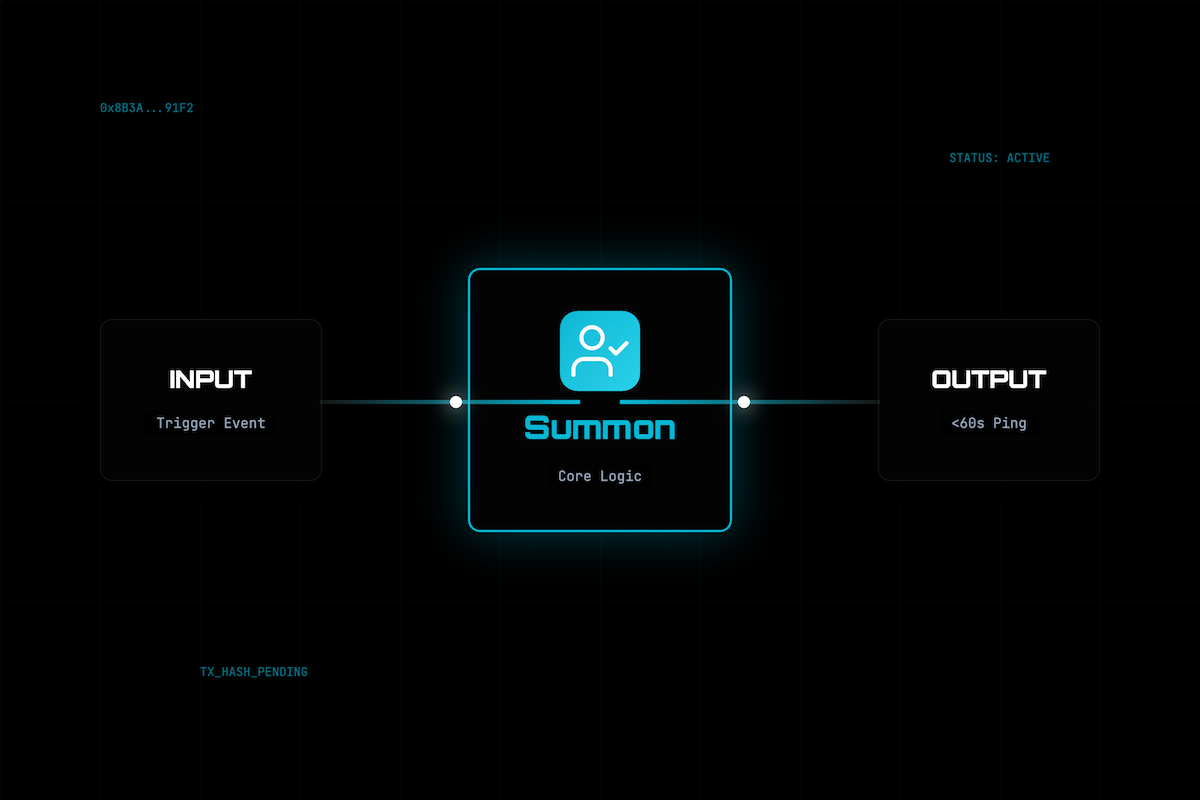
A run, end to end
Built on croo-core
The SDK is the engine
Summon runs as an on-chain provider through five methods of the shared croo-core SDK. Drop it into any catch block:
makeClient() | Shared CROO client, Base Mainnet config |
runProvider() | The provider loop — fulfils incoming sign-off hires |
isMockMode() | Branches to offline execution |
getNegotiation() | Reads order state during a hire |
getDownloadURL() | Resolves the deliverable for the human to review |
// drop this in your catch block —
// a human decides instead of your bot guessing
const { delivery } = await hire<{
  approved: boolean;
}>(client, {
  serviceId: '4d8cbcb2-bfc7-4b60-b6f9-7919ff81e574',
  requirement: {
    prompt: 'Approve sending 500 USDC to 0x…?',
    context: JSON.stringify(failedPayload),
  },
  maxPrice: 1.0,
});

if (delivery.approved) { /* proceed safely */ }
The constellation
Summon in the network
Any agent can buy a human decision — escrow-backed, refundable — on one shared SDK: croo-core.
“An agent pays a human for a yes/no, with escrow and an SLA refund” has nowhere to exist on a normal API marketplace. There is no mechanism to hold the money while a person makes up their mind, and no way to return it automatically when they don't.